
Reviews
Franchise social media: a practical operating framework
A practical franchise social media framework for account roles, local content, customer responses, access controls, disclosures, paid work, and measurement.
What to take away
- Set the role of national, regional, and local accounts before choosing a publishing tool.
- Give locations room to be useful without letting facts, access, or brand identity drift.
- Treat comments and messages as customer operations, not simply engagement.
- Measure completed business outcomes and service quality alongside platform activity.
Franchise social media is a shared operating system for one brand and many local businesses. It covers account ownership, content, community response, paid distribution, creator work, customer care, security, evidence, and measurement. The central challenge is not posting more often. It is making every public account recognizable, locally useful, and accountable when dozens or hundreds of people participate.
Decide what social media must accomplish
Start with business jobs, not platforms. A restaurant location may need to publish accurate hours, answer menu questions, resolve service problems, and support local events. A home-services brand may need to explain the work, qualify a request, route a lead, and show verified local experience. Separate recruitment, franchise development, customer marketing, and support objectives; for franchise-development recruiting, use LinkedIn and franchise portals to invite inquiries, route each to an owner who can verify territory availability, and keep Indeed employee-hiring posts distinct from franchise-sale claims.
Social media jobs and owners
Job
- Local discovery
- Identity, area, hours
- Education
- Answers, demos, limits
- Community response
- Response time, resolution
- Demand
- Qualified local action
- Reputation
- Issue themes, resolution
- Recruitment
- Audience, claims, handoff
Evidence
- Local discovery
- Location ops
- Education
- Subject reviewer
- Community response
- Customer care
- Demand
- Marketing and sales
- Reputation
- Ops and comms
- Recruitment
- Franchise development
Owner
- Local discovery
- Education
- Community response
- Demand
- Reputation
- Recruitment
| Job | Useful evidence | Primary owner |
|---|---|---|
| Local discovery | Accurate identity, area, hours, and action | Location operations |
| Education | Clear answers, demonstrations, and limits | Subject reviewer |
| Community response | Response time, resolution, and escalation | Customer care |
| Demand | Qualified local action and cost | Marketing and sales |
| Reputation | Issue themes and verified resolution | Operations and communications |
| Recruitment | Correct audience, claims, and handoff | Franchise development |
Map the account architecture
Inventory every brand, market, location, executive, and employee; every creator, ad, and legacy account. Record public name, handle, URL, platform, purpose; status, owner, administrators, recovery method, agency access.
Record next review; identify duplicates and accounts controlled by former staff; close no account until customer impact, archive needs, handle transfer, and recovery are weighed. A full account inventory also feeds the location data that local franchise marketing needs for accurate listings and reviews.
Choose an architecture that reflects real capacity. A brand account can carry broad campaigns and service information. Regional accounts can work when markets have distinct language, offers, or operations. A location account should exist only when someone can maintain accurate facts, original local material, and timely replies. An empty local handle is not localization.
Name the actual channels in the inventory: Facebook and Instagram, TikTok, YouTube, and LinkedIn. Meta Business Suite offers publishing, scheduling, and inbox tools for Facebook and Instagram; YouTube Studio is the native channel-management tool for YouTube. Treat these as examples, not endorsements, and record each platform's current publishing, moderation, administrator, and recovery controls rather than assuming permissions transfer.
Write a practical governance charter
- Which accounts may exist and who approves a new one
- What the center supplies and what locations may create
- Required fact, accessibility, rights, and disclosure checks
- Response times by question, complaint, threat, and crisis
- Who may publish, advertise, moderate, export, and remove access
- How content, conversations, and decisions are retained
- What happens during transfer, closure, agency change, or compromise
Keep the charter short enough to use, then attach detailed playbooks for recurring work. Franchise agreements, employment rules, privacy duties, platform terms, and local law may affect the design. The operating team should obtain appropriate legal advice rather than treating a general marketing guide as a substitute.
Governance charter essentials
- Which accounts may exist and who approves
- What center supplies and locations may create
- Required fact, accessibility, rights, disclosure checks
- Response times by question, complaint, threat, crisis
- Who may publish, advertise, moderate, export, remove
- How content, conversations, decisions are retained
- What happens during transfer, closure, agency change
Control endorsements and material connections
The Federal Trade Commission's Endorsement Guides (16 CFR Part 255) address disclosing material connections: an endorser-seller connection that could materially affect an endorsement's weight or credibility must be disclosed when the audience would not reasonably expect it. The FTC's * .com Disclosures: How to Make Effective Disclosures in Digital Advertising* is also relevant to making online disclosures clear and conspicuous.
Examples cover payments, employment, family relationships, and free products. Tags and other circumstances also count; apply the rule to the actual message and seek legal review for specific campaigns.
Create one review path for franchisees, employees, creators, customers receiving incentives, vendors, and agencies. A platform label may help, but the team should confirm that the disclosure is clear in the post, image, video, audio, or live content people actually experience. Store the approved claim, supporting evidence, connection, disclosure language, date, and responsible reviewer with the asset.
Build a local content system
A useful calendar mixes centrally produced assets with verified local reporting: central material can cover brand stories, product education, national campaigns, templates, and regulated language. Local material can cover people, availability, community activity, weather effects, and access. It also can cover events, work examples, and market-specific questions.
Central and local content roles
Content type
- Offer
- Terms, design, dates
- How-to
- Method, safety, claims
- Team
- Consent, brand standards
- Community
- Selection, disclosure
- Customer story
- Permission, claim review
- Urgent update
- Template, escalation
Central control
- Offer
- Availability, fulfillment
- How-to
- Local example, question
- Team
- Current people, roles
- Community
- Verified event, partnership
- Customer story
- Accurate experience, context
- Urgent update
- Confirmed local status
Local contribution
- Offer
- How-to
- Team
- Community
- Customer story
- Urgent update
Every local fact needs a source and an owner who can correct it, and the central-local mix works only when the franchise marketing strategy defines who funds and approves each piece.
| Content type | Central control | Local contribution |
|---|---|---|
| Offer | Terms, design, dates, exclusions | Availability and local fulfillment |
| How-to | Method, safety, and claims | Local example and common question |
| Team | Consent and brand standards | Current people and roles |
| Community | Selection rules and disclosure | Verified event or partnership |
| Customer story | Permission and claim review | Accurate experience and context |
| Urgent update | Template and escalation | Confirmed local status |
Use a brief that prevents avoidable errors
Each post should state the audience, customer question, business job, platform, format, local field, evidence, rights, disclosure, accessible alternative, action, approver, publication window, response owner, and removal trigger. The brief should also say what must not be inferred. A short video about a service cannot imply that every location offers it unless availability is verified.
Design for accessibility and comprehension
Write captions that carry meaning, not repeat decorative text, and add useful alt text where the platform supports it. Caption spoken video accurately and provide a transcript when the format or audience needs one.
Avoid essential info that's shown only as color, tiny text, fast animation, or sound. Test the post on a phone, with sound off, and with the platform's current accessibility controls.
Use the Web Content Accessibility Guidelines (WCAG) 2.2 Level AA as a documented review benchmark. Check applicable legal duties separately; conformance is not a substitute for legal review.
Treat community management as operations
Define question categories and routes before volume: local hours may need a location manager; billing complaints may need customer care. Name a community manager to monitor and acknowledge, an escalation lead to own urgent handoffs, and a designated spokesperson for press inquiries. A safety report, threat, discrimination allegation, privacy issue, or legal demand needs immediate controlled escalation. A press inquiry needs the spokesperson, not an improvised public response.
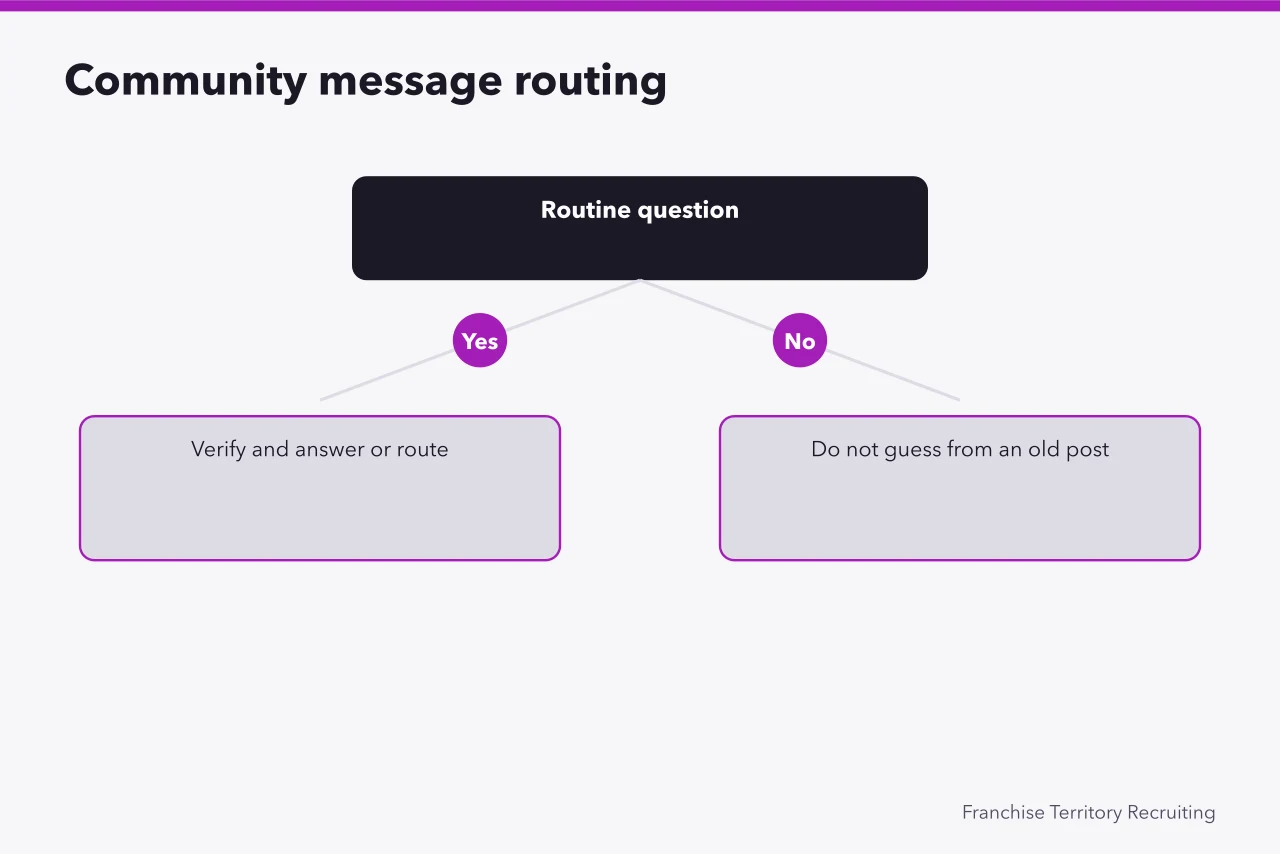
The community manager should acknowledge only what the team can confirm, avoid arguing in public, protect personal information, and document the handoff.
| Message | First action | Do not |
|---|---|---|
| Routine question | Verify and answer or route | Guess from an old post |
| Service complaint | Acknowledge and move details securely | Demand sensitive data publicly |
| Safety concern | Escalate under the incident plan | Promise an outcome before facts |
| Threat or harassment | Preserve evidence and use policy | Expose staff or retaliate |
| Media inquiry | Route to the named spokesperson | Offer an unauthorized statement |
| Account compromise | Secure access and activate response | Delete evidence casually |
Protect access and continuity
Use company-controlled accounts, named users, role-based permissions, multifactor authentication, secure recovery, and a current access register. Shared passwords hide responsibility and make offboarding harder. Limit agencies to the functions they need, review permissions on a schedule, and remove access immediately after a role or vendor change. Export essential data and preserve creative files outside a vendor dashboard.
Connect organic and paid work
Organic posts can reveal recurring questions, credible local stories, response needs, and creative patterns. Paid media can distribute a controlled message to an eligible audience. Keep approval, targeting, exclusions, landing experience, local availability, tracking, and spend authority explicit. Do not boost a popular post until rights, claims, comments, and local fulfillment have been reviewed.
Measure a complete customer path
| Layer | Measure | Caution |
|---|---|---|
| Production | Approved and on-time useful posts | Volume is not value |
| Distribution | Eligible reach and frequency | Platform definitions differ |
| Response | Meaningful views, replies, saves, or visits | Activity may be negative |
| Local action | Calls, bookings, orders, visits, or applications | Matching can be incomplete |
| Economics | Contribution after media and operating cost | Lag and capacity matter |
| Quality | Cancellations, complaints, and resolution | A conversion can still fail |
Report by platform, market, location cohort, content job, paid status, and time. Preserve counts and definitions instead of showing percentages alone. Annotate outages, platform changes, promotions, account launches, operational constraints, and tracking releases. A strong post can be a creative clue, but it is not automatically a repeatable business result.
Measure the full customer path
Layer
- Production
- Approved, on-time posts
- Distribution
- Eligible reach, frequency
- Response
- Views, replies, saves
- Local action
- Calls, bookings, orders
- Economics
- Contribution after cost
- Quality
- Cancellations, complaints
Measure
- Production
- Volume is not value
- Distribution
- Definitions differ
- Response
- Activity may be negative
- Local action
- Matching incomplete
- Economics
- Lag and capacity
- Quality
- Conversion can fail
Caution
- Production
- Distribution
- Response
- Local action
- Economics
- Quality
Run a maintainable cadence
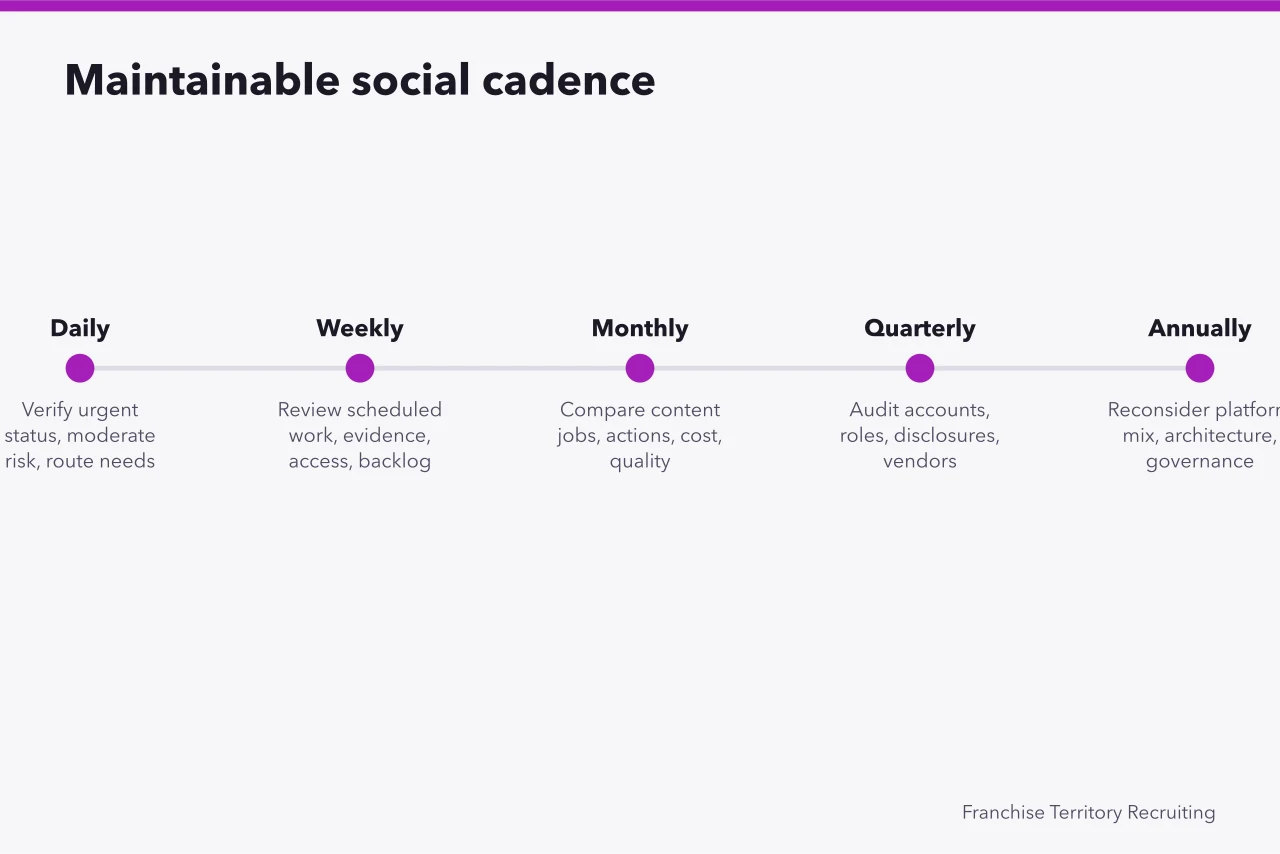
- Dailyverify urgent status, moderate risk, and route customer needs
- Weeklyreview scheduled work, local evidence, access changes, and response backlog
- Monthlycompare content jobs, local actions, cost, and quality by cohort
- Quarterlyaudit accounts, roles, disclosures, rights, vendors, and escalation drills
- Annuallyreconsider platform mix, account architecture, governance, and measurement definitions
A franchise social program earns attention by being useful and earns trust by staying accurate. Central standards should make good local work easier, not erase it. Local freedom should produce relevant evidence, not uncontrolled claims. When identity, access, content, response, and measurement share one operating model, the network can learn without making customers absorb its complexity.
Verify account governance before launch
Before release, assign each account in writing to the franchisor or franchisee entity responsible for it; do not leave ownership implicit in a personal login or agency relationship. Record the owner, administrators, recovery method, publishing authority, and the people who can export data or remove access. Give employees and vendors only the permissions their roles require.
Make the franchise agreement and vendor agreement address account control, data access, creative-file delivery, and transition or closure. For a franchise transfer or termination, specify who initiates the handoff, how records and assets are delivered, and who can recover the account. Obtain legal review of contract language rather than treating an operating guide as a substitute.
Check the platform's current native roles and recovery settings against the intended arrangement. Confirm that the organization identified as owner can regain access without relying on one employee or agency, that location staff cannot exceed assigned publishing authority, and that access can be removed when responsibilities change.
Record the tested roles, recovery path, exceptions, contract owner, and approval date in the account inventory. Repeat the review after a material change in staffing, ownership, platform settings, vendor, or account purpose. These checks make control and continuity explicit; they do not replace platform terms, applicable law, or legal advice.
Common questions
Should every franchise location have its own account?
Only when the location has a distinct customer need and enough capacity to maintain accurate content, responses, access, and records.
Who owns a franchise social account?
The account owner should be the franchisor or franchisee entity designated in writing—not an individual employee or agency by default. Keep recovery and administrative control with that entity, and define transfer, data access, and closure in franchise and vendor agreements.
How often should franchises post?
Use a cadence the team can sustain with useful, approved material. Frequency without relevance, response capacity, or operational support creates noise.
Can franchisees create their own content?
They can within a defined system that covers permitted topics, facts, claims, rights, disclosures, accessibility, approval, response, and removal.
What is the best social media metric?
No single metric is enough. Connect valid distribution and response to completed local actions, economics, and customer quality.
In this guide
- Common franchise social media questions for local teamsCommon franchise social media questions for local teams: account access, territory-aware posts, recruiting inquiries, approvals, disclosures, and reports.
- How to Improve Franchise Social Media: Diagnose & TestHow to improve franchise social media by checking account, content, distribution, response, and outcomes, then testing one change on comparable locations.
- Franchise social media examples for local marketingFranchise social media examples show how six brand campaigns pair central messaging with local details, disclosures, accessible posts, and practical follow-up.
- Common franchise social media mistakes: shared passwords and vanity metricsFranchise social media mistakes include unclear ownership, generic posts, unsupported claims, weak disclosures, poor security, and vanity reporting.
- Franchise social media checklist: the items people skipFranchise social media checklist: who owns the account, local facts, disclosures, accessibility, and the FTC Franchise Rule and FDD checks.
- Franchise social media benchmarks from your own cohortsFranchise social media benchmarks built from your own cohorts: six layers to measure, how to compare like locations, and thresholds that trigger action.
- Account coverage and exit cost separate franchise social media tools worth buyingCompare franchise social media tools on account coverage, approval routing, data export, and exit cost rather than the longest feature list.
- Franchise social media best practices for safer operationsFranchise social media best practices for accurate local content, honest endorsements, secure account access, privacy, and customer response.
- Which franchise social media agencies actually disclose their real client list?Franchise social media agencies that name real clients in public case studies, and the checks that separate a disclosed roster from a logo wall.
- Franchise social media trends: five recruiting hypothesesFranchise social media trends are hypotheses to test, not forecasts. Five recruiting tests cover local proof, comments, discovery, automation, and response.